Yates/Juhl American Persimmon
A Long-Time Favorite of Many
First introduced in 1956, it has been a favorite ever since due to its good sized fruits, excellent apricot-honey flavor and wonderfully heavy cropping.
Price range: $54.99 through $74.99
A Long-Time Favorite of Many
Originally introduced by Talbott’s Nursery around 1956 under the name “Juhl”, this cultivar was later re-discovered by Ed Yates of Cincinnati, OH in 1983 and was distributed under his own name, “Yates”, believing it to be a new cultivar. James Claypool eventually determined that “Yates” and “Juhl” were the same cultivar and the names have been used interchangeably for many years.
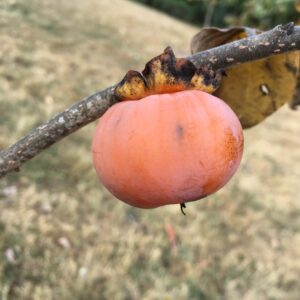
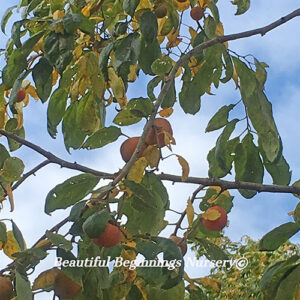
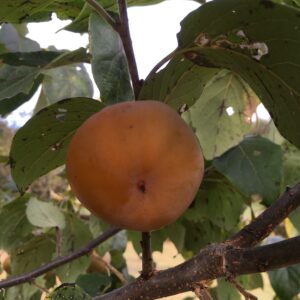
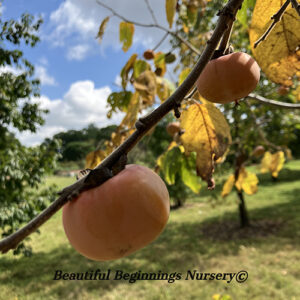
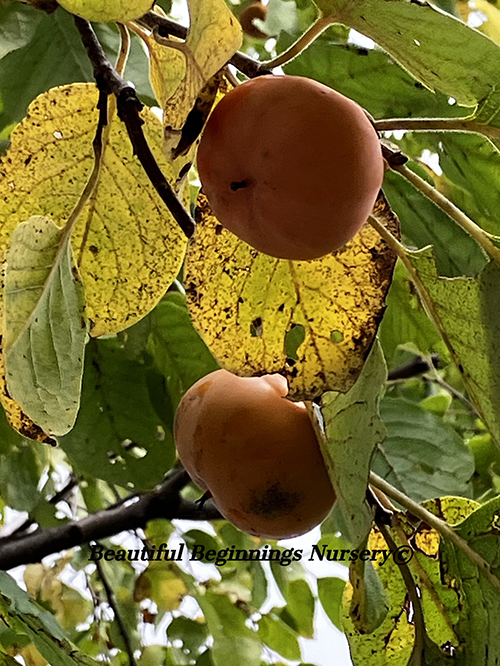
The fruits are medium-large in size, averaging 1.5-2+ inches with a wonderfully rich apricot-honey flavor. The tree bears a heavy crop of deep orange to orange-red fruits that ripen very early in the season, extending the harvest window significantly. Another nice characteristic of this cultivar is that is has a lower number of seeds to fruit ratio meaning you get more pulp with each fruit. “Yates” is a proven favorite and winner, having stood the test of time for nearly 70 years.
- Introduced in 1956 by Talbott’s Nursery under the name “Juhl”
- Rediscovered and reintroduced by Ed Yates in 1983 under the new name “Yates”
- Medium-large sized fruits
- Excellent fruit quality with apricot-honey flavor
- Low seed to pulp ratio
- Very early ripening
- Ripens/Drops early Autumn (August-September)
USDA zones: 5b-9
Spacing: 15-20 foot centers
Grafted onto: Diospyros virginiana (Native American persimmon rootstock)
Other Considerations: Grafted American persimmons do not require a second cultivar for cross-polination. (This means that you do not need to buy two trees with different names.)
Beautiful Beginnings persimmons have highly-developed and extensive root systems that set your tree up for success from the very beginning by helping it to anchor well and grow vigorously with proper care.
All persimmons are shipped dormant and bareroot in the Spring.